Thread Running Through – Textilia 3

Thread Running Through – Textilia 3

16 September – 7 November 2021

The landscape in which we live, meet and work is a northern landscape largely shaped by cloth. Distinctive weavers’ cottages line the canals and perch on hillsides, tall mill chimneys dominate the valleys. We meet in a grand and richly furnished manor house created by mill owners, exhibit, and seek inspiration and materials at converted mills in Yorkshire, Lancashire and Cumbria. Some of us have mill workers in our ancestry, weaving in our memories and in our blood.
We are drawing on this rich history to create a series of exhibitions in 2019/20, exploring the thread that runs through our stories, landscapes and work, creating a body of work that weaves together mill workers and owners, beauty created, and price paid, the heritage we live and take forward.
The artists in Textilia 3 use many diverse techniques, including hand and machine stitch, felt, appliqué, mixed media and painting, ceramics, dyeing and resists, print and manipulated fabrics and fibres. Abstract, figurative, and decorative pieces, wall art, 3D and wearable art are all included as well as a wide range of smaller textile items and cards.
Textilia 3 is a well-established group of 16 contemporary textile artists, based in the North of England, who have exhibited widely in Yorkshire, Lancashire, and Cumbria over the last 25 years. We have built up a popular following of loyal visitors who regularly travel to see our work. Recent exhibitions have included site inspired works for Gawthorpe Textile Collection, Cliffe Castle Museum, Keighley and Fountains Abbey, as well as themed exhibitions at Ilkley Manor House, Skipton Town Hall and The Station, Richmond.
Susie Martin

Susie Martin

Autumn – Susie Martin

Those Summer Nights – Susie Martin

Lazy Summer Days – Susie Martin

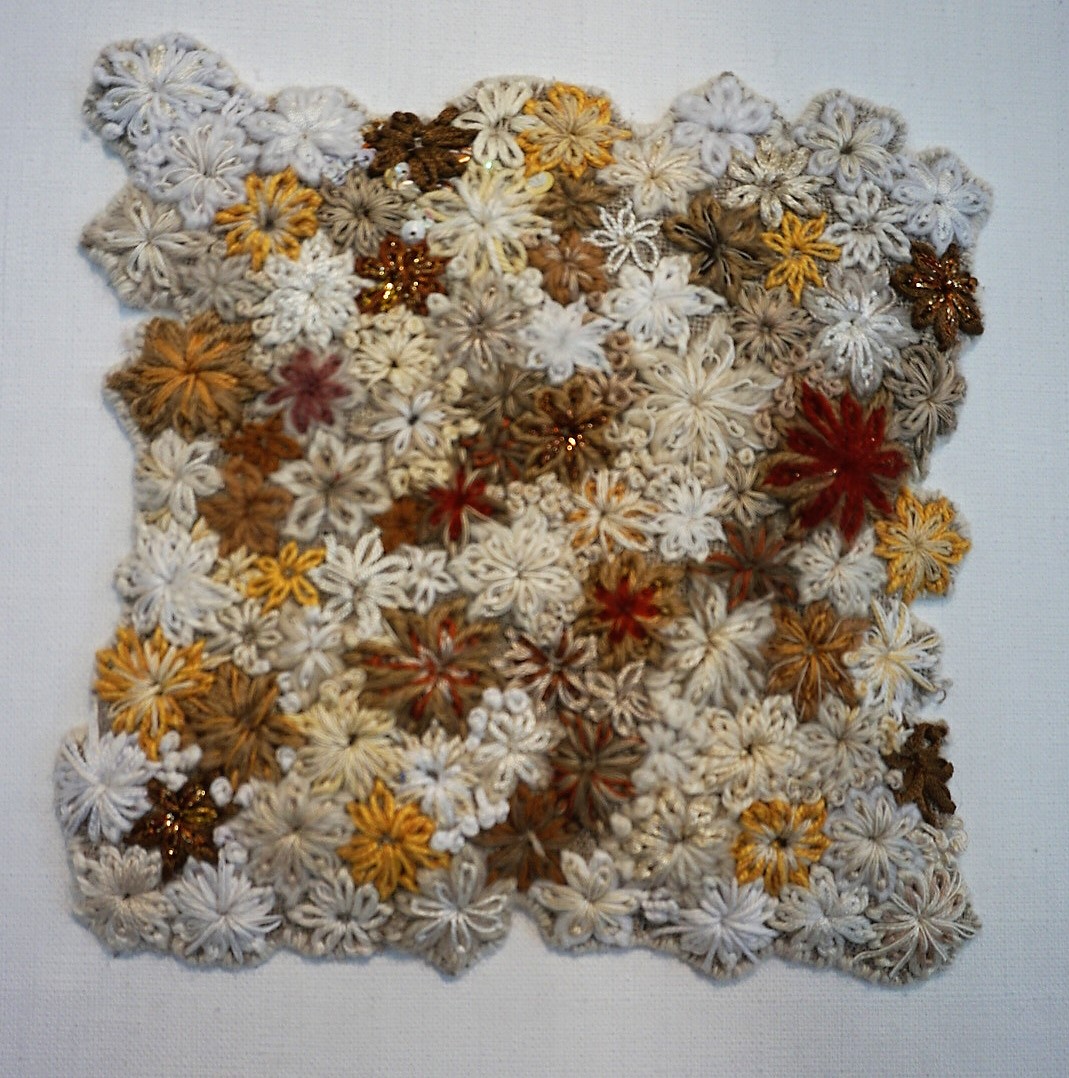
Daisys Dream – Susie Martin.

The One that Saved me in Lockdown – Susie Martin.

Winter Wonderland – Susie Martin

Green Green Grass of Home – Susie Martin

The Skies of Blue – Susie Martin.

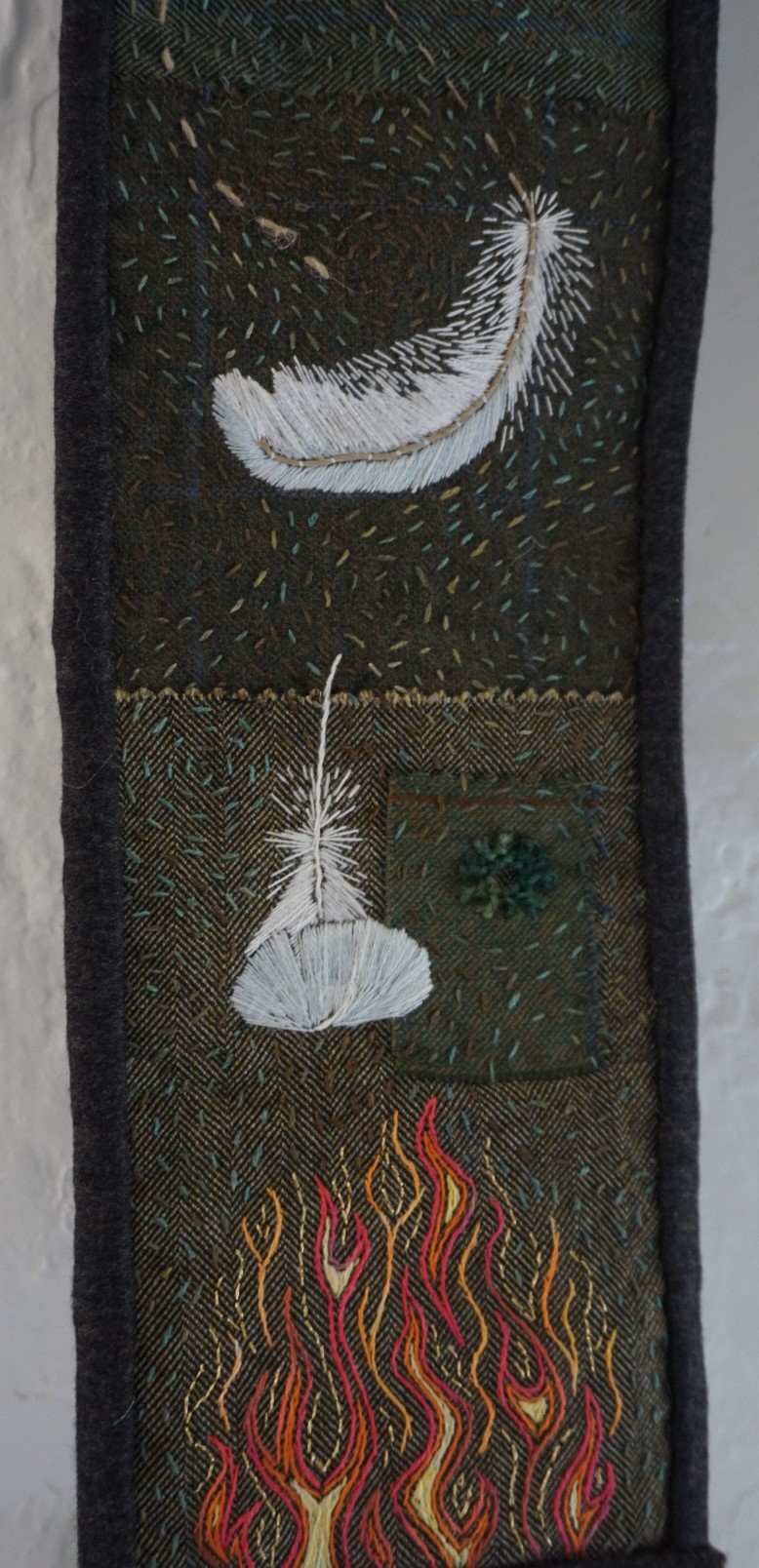
The Thread running Through. Each one is created on a journey  weaving its way. Guided by the needle in my hand, in form, as a stitch. I have already chosen which thread to use, what colour, texture. All that is left is to decide where to take that thread, what shape to create with it, to find its place in the greater design. The Thread can follow a pattern or take its own path. Existing with others next to each other or overlapping to create a new design. Threads hold together the pieces, can be used to mend or be for pure decoration.

Every different colour and texture join together in stitch to make a world of difference or live side by side in harmony and blend in or stand out. A single thread can also say so much. It can change course, snag, break knot, or tangle or fray creating its own beauty or destruction, causing frustration or happy happenstance. So many threads, so many possibilities and so many different possible outcomes. As a textile artist, specialising in Hand stitching and colour, I collect thread and yarn like a quilter collects fabric. I have multitudes of boxes and tubes full of threads. Bags full of wool. They are organised by every colour of the rainbow and every shade in between. I have silks, cottons, wools, synthetics, metallics, shiny, matt, thick, thin, furry, sparkly and some chewed by the kitten. In this body of work, in response to the title. I have let the threads speak for themselves. I have reduced my stitch to just one, the detached chain stitch. I have lost count of all the different threads I have used. All sewn by hand over many, many hours, all supervised and approved by the kitten during lockdown of 2020.

Margaret Laycock

The Pinny – Margaret Laycock

The House Keeper – Margaret Laycock

Margart Laycock

Details of the Butler and the Gardener – Margaret Laycock

The Pinny is the oldest item of clothing which has remained virtually unchanged from the time of the ancient Egyptians to the present day. Its original purpose, which has changed as little as its shape, was to protect clothing during work. They were also used in religious and cultural ceremonies as well as in national costumes. ‘A thread Running Through’ history and society. In the course of the last 500 years, it has on occasion formed part of fashion. In such circumstances it is made of fine materials and embellished with embroidery. Pinnies also indicated a person’s occupation and status in society. This situation was reflected in the cities, towns, and villages throughout the land and none more so than the staff in the grand homes and manors. The mill worker repaired her worn pinny with patches, then patched them again – ‘more patches than pinny’. The butler wore green with a silk backed waistcoat. The gardener wore blue and the housemaid traditional white. My four interpretations include wood samples from Yorkshire me mills. Green silk and cotton, pieced and manipulated with a buckle at the front instead of the back of the waistcoat for the butler. Blue for the gardener uses indigo dyed fabrics. The housemaid wore a traditional bib fronted pinny with a bow.  These colours were traditional and recognised countrywide – everyone knew their place.

Linda Dewart

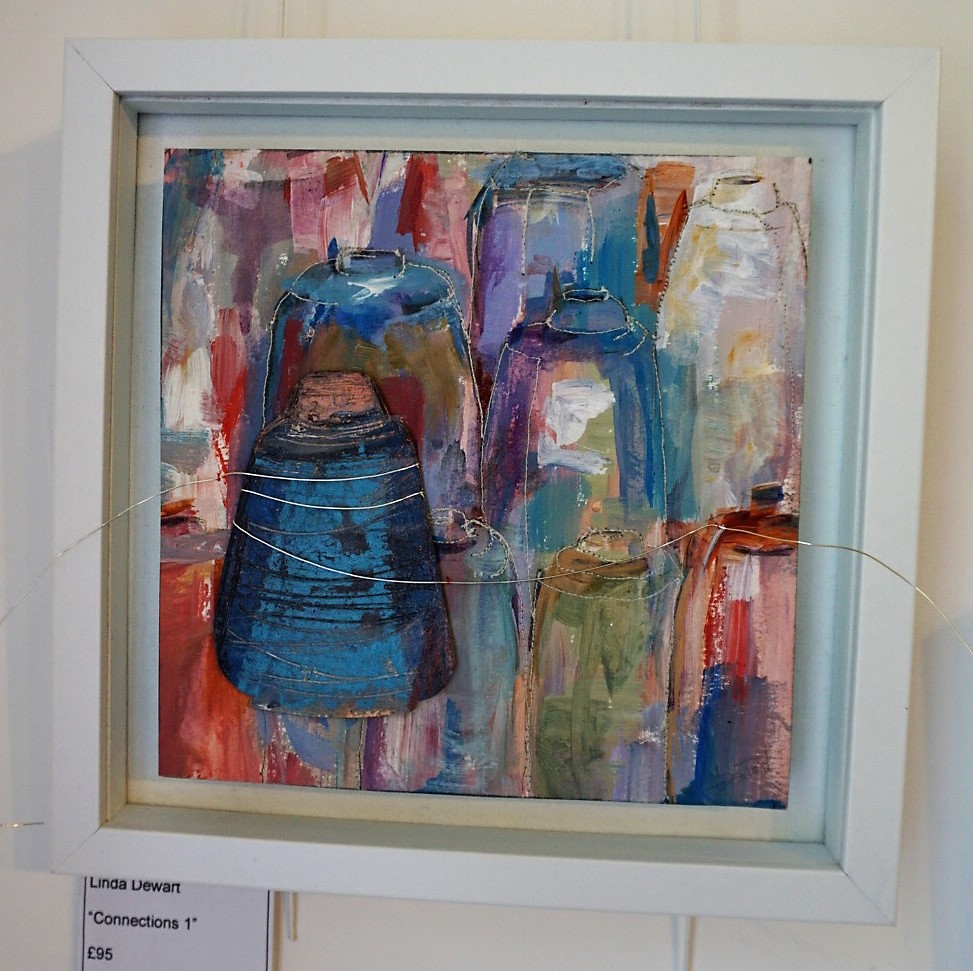
Connections 1 – Linda Dewart

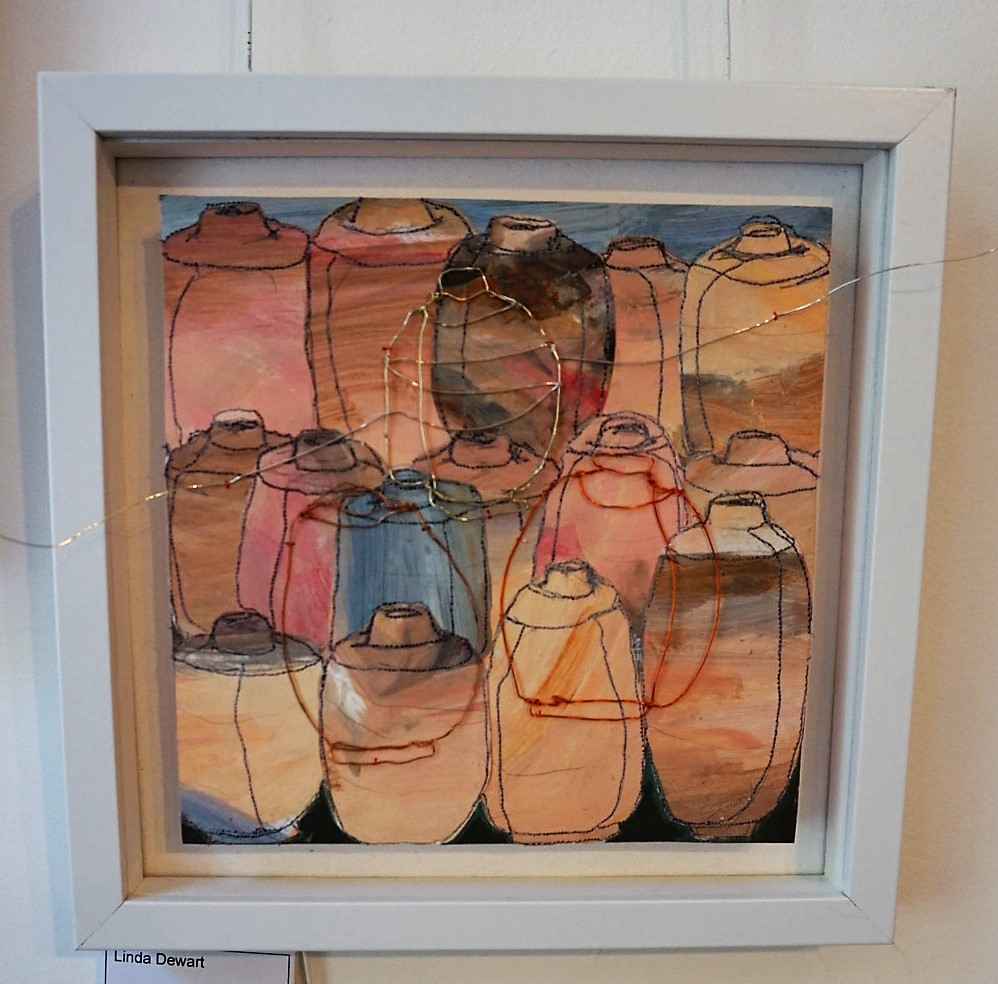
Connections 2 – Linda Dewart

Connections 3 – Linda Dewart

To me threads are like paths. They will get tangled and messed up if not looked after properly but they are also great for tying things together whether it be a button on a coat or connecting homes, villages, and town together. For this exhibition I have been thinking further afield to a path that links the great textile centres all over the world. That common denominator – a basic thread – runs through everything from the looms of India and China to those here at Farfield. I work in mixed media with stitch and my ‘Connections’ pieces have been inspired by both the vibrant colours of India and the fabulous cones of colour left over by weavers closer to home.

Jo Valentine

Muted – Jo Valentine

Shroud – Jo Valentine

Fate Weaving – Jo Valentine

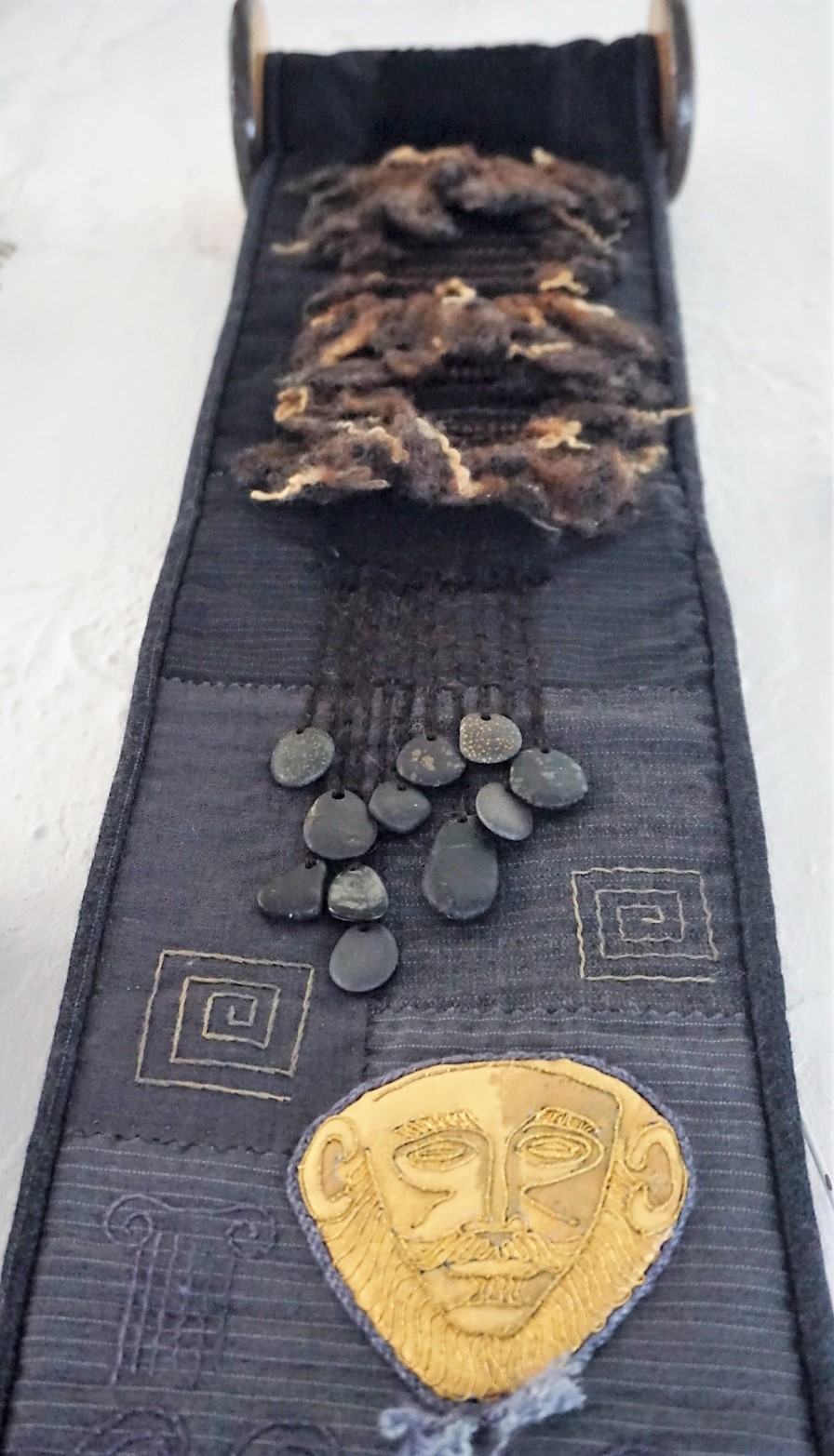
Stitch runs through our valleys, our landscapes, and our stories. We weave tales and spin yarns. ‘Text’ and ‘Textile’ are both rooted in the Latin verb ‘texere’ which means ‘to weave’. In Sanskrit ‘sutras’ are threads and also rules or aphorisms. In the valley where I live, you can still see the old pre-industrial revolution weaver’s cottages where wool weavers sat at their looms on the top floor or cotton weavers on the bottom, supplied with thread, before the spinning mills, by groups of spinsters. I imagined the stories these women would tell each other and their families as they sat at their wheels, before the clatter of the mills silenced their voices. Many are the tales that have been passed down from our ancestors that feature that magical significance of spinning, weaving and fabric. I have begun to explore some of my favourites here in stitch. The fabrics used in all three hangings are wool samples from Yorkshire and Lancashire mills. The weaving incorporated are made from relevant thread – nettle, Shetland wool and sea silk (seaweed and silk).

Claire Kettleman

Jouney 1 – Claire Kettleman

Journeys 2 – Clare Kettleman

Jouney 3 – Claire Kettleman

From hill farmer to wealthy mill owners in just a few generation, my work charts the progress of single Pennine family through their properties and the road that links them. I walked in their footsteps sketching the buildings and landscape that I now share, my time measured in hours spanning centuries of their lives. That road has changed considerably in the short 30 years that I have known it, but still reveals the essence of their tradition and glimpses of the past that would be instantly recognised by the original family members.

My Three wall hangings are constructed from strips of different fabrics: cottons for the original mill use, wool for the product that made the family fortune, and silk to represent the aspiration of the mill owners as they became international traders. The composite cloths are hand dyed, each surface texture absorbs the colour in a slightly different way giving natural pattern and interest. The final process involves printing outlines of buildings using a bleaching paste. I have continued the print technique using plants harvested from the roadside and them embellished with appliqued fabric and hand stitching.

Catherine Slater

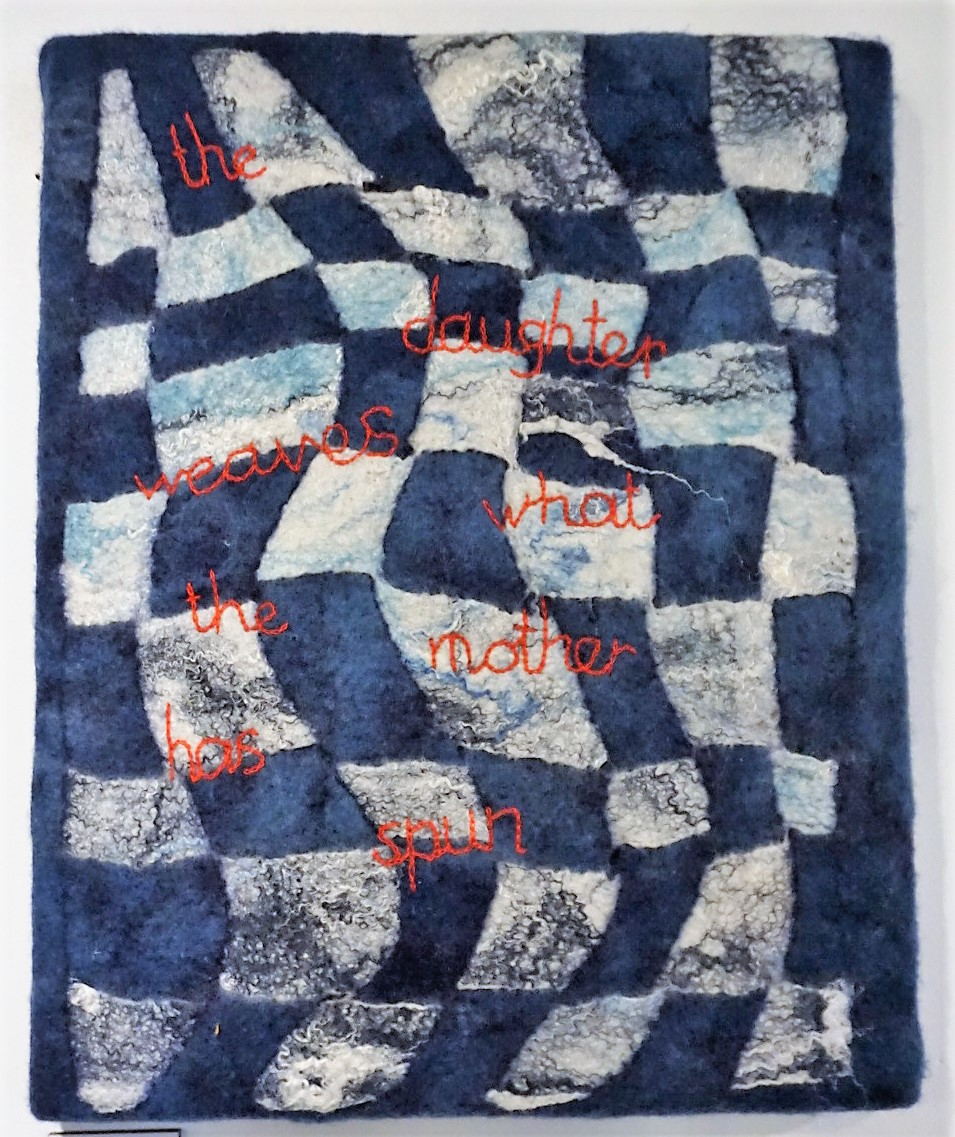
The Daughter Weaves what the Mother has Spun – Catherine Slater

Threads of Innocence and Experience – Catherine Slater.

I really enjoyed the challenge of this exhibition title. It made me re-appraise the way that threads and fibres have run through my artwork over the years and see continuing themes through a range of different subject matters.

The interest in phrase from the weaving industry led me to research other sayings, quotes, and stories about wearing, from ancient history, through Shakespeare to ones in current use. I have been surprised by the richness and breadth of such saying and enjoyed exploring ways to incorporate them into my work.

Julie Coghlan

Windows 1-9 – Julie Coghlan.

Windows 19-27 – Julie Coghlan

Windows 28-36 – Julie Coghlan

Window – Julie Coghlan

Window – Julie Coghlan

Window – Julie Coghlan

Textile manufacturing during the Industrial Revolution in Britain was centred in and around Lancashire and Yorkshire. The development of the Textile industry had a fundamental impact on the economy, population, and architecture and by the end of the 19th century 500,000 out of 4 million people in Lancashire were employed in the industry. England’s entrepreneurial merchants wholeheartedly embraced the Industrial Revolution and consequently became very wealthy.

But was there fair distribution of this wealth with the poor people who had helped to create it?

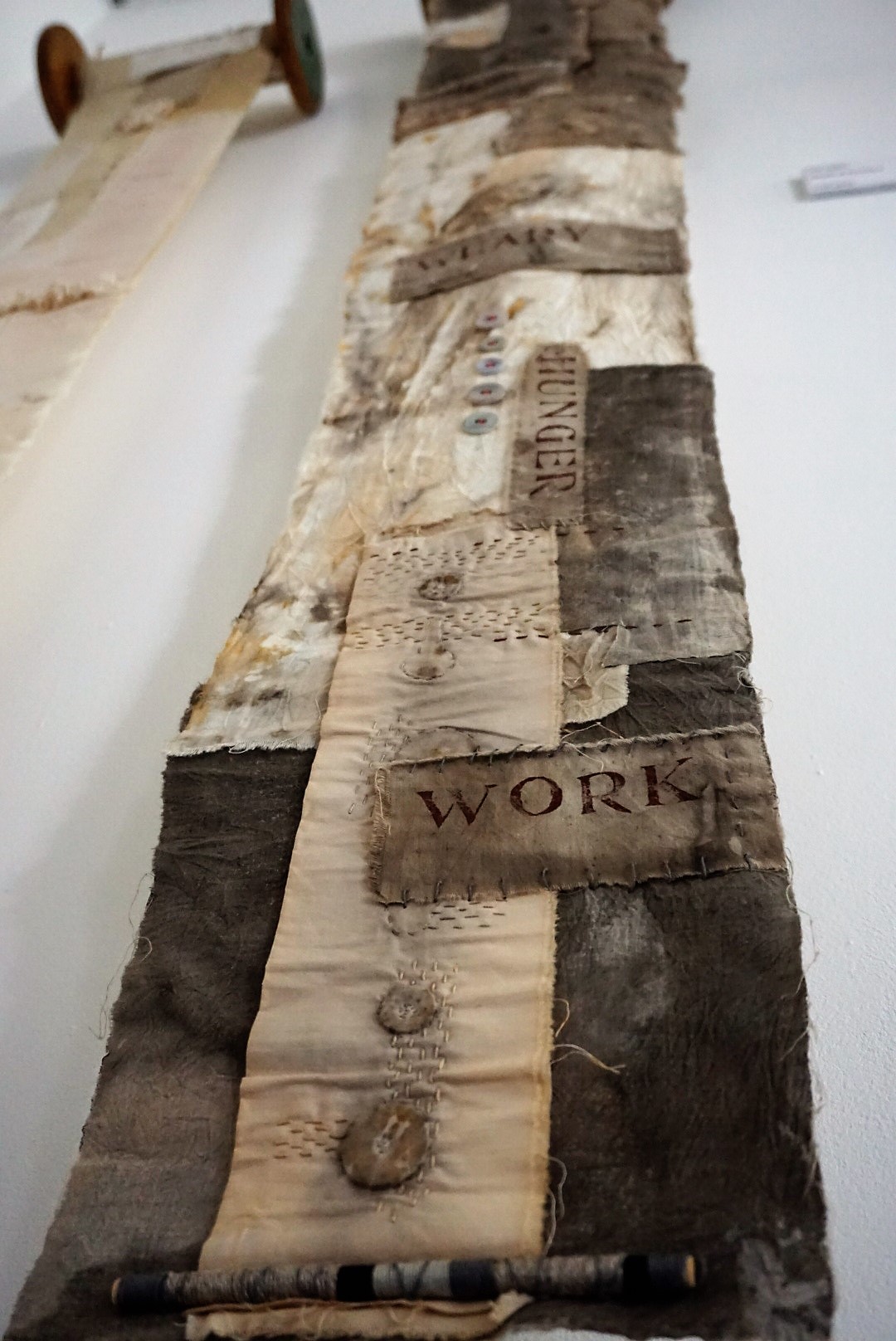
The ‘Thread Running through’ my work is depicting Mill life from both sides. Laying underneath old weaving looms enabled me to see the angular shapes from a child’s perspective. Additionally, the windows, stones and works entrances at Bridgehouse Mill (Haworth) and Farfield Mill (Sedbergh) were hugely inspirational, providing me with colour and texture. Fabrics worn by the wealthy and the poor are layered using my favourite mixed media technique combining weaving, hand and machine stitching, collage, and ceramics.

Sue Ingles

Wealth & Poverty – Sue Ingles

Poverty – Sue Ingles

Poverty – Sue Ingles

Poverty – Sue Ingles

We know that children were unfortunately thought to be an essential part of the workforce in 19th C Mills. As cheap labour, they were not in a position to question their lot and their meagre wages were a necessary supplement to the family income. Long hours meant little time for education and play.

The privileged children of the mill owners were also dependent on the mill. Their comfortable lives were only possible if the business was profitable. They were educated, clothed, and fed and had time to play with expensive toys, all due to the Mill.

This body of work comments on the common thread of interdependency between these two very different groups of children. Whilst many of the mill-owners are still remembered, the vast number of workers remain largely anonymous but are no less important.

Gemma Kelmanson

Gemma Kelmanson

Gemma Kelmanson

Gemma Kelmanson

With so many mills and grand houses linked to the textile industry in Yorkshire, I have begun to explore some of this rich history and its wealth of treasures.
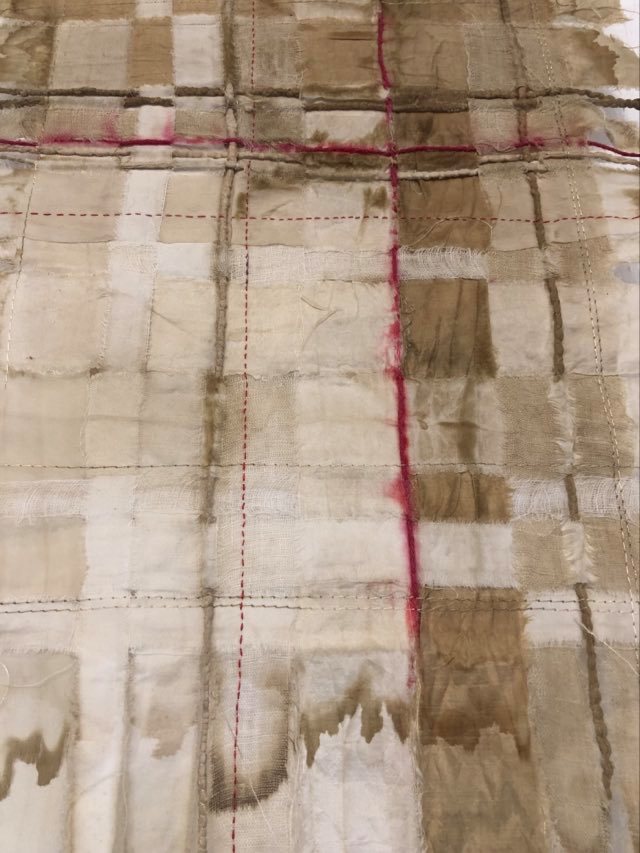
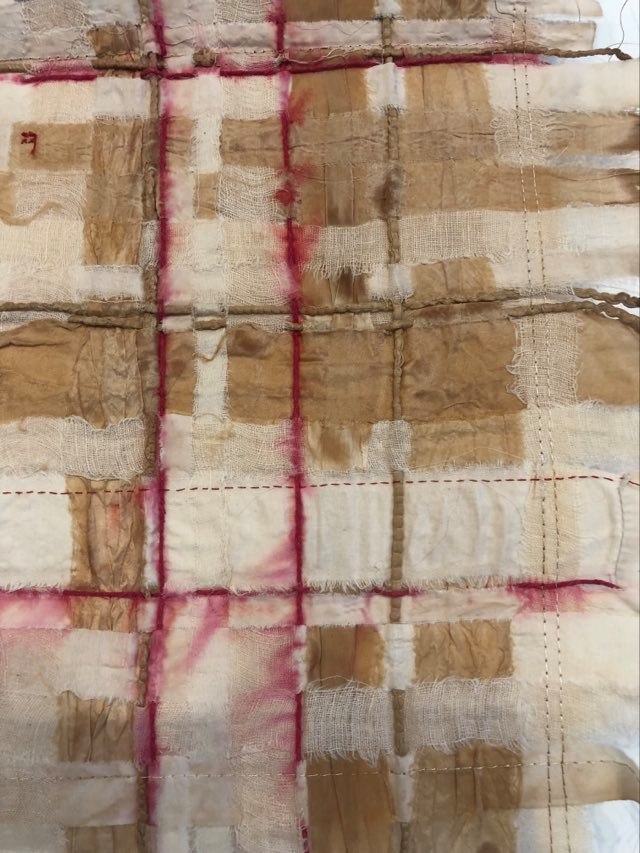
A red thread … it is found in so many places!
A red thread identified where the household linens and undergarments were to be returned to after laundering.
A red thread identified an item in need of mending …
A red thread identified the colour changes in a sample of woven cloth …
Using recycled fabric and natural dyes, my work for Thread Running Through explores some of these themes, mixing simple weaving techniques with hand and machine stitching.

Annie Smith

Rust Findings – Annie Smith

More textiles are produced today throughout the world more than ever before. The industry and craft that was developed in Yorkshire and Lancashire in the Victorian age has now spread across the globe.

Farfield Mill is an amazing building which is a legacy of that age when mill owners created buildings and homes that have survived the ravages of time. However, textile mills that have mostly been repurposed as homes, offices and exhibition spaces, leaving us the history and voices of the past. Time affects us all, garments, threads, and fabrics deteriorate, structures weaken and buckle, metal rusts and dulls. At the same time magic happens developing character, texture, and patina. Thankfully many items have been preserved in museums and as home treasures, which gives us the chance to pause and consider the memories and voices of the past.

Jan Dowman

Sheep – Jan Dowman

Sheep – Jan Dowman

Sheep – Jan Dowman

While walking in the Yorkshire Dales I came across the carcase of a dead sheep in a muddy riverbed. It had been unable to free itself from the mud. The position of the decaying carcase showed clearly the struggle it had gone through, its thin legs unable to support it because of the weight of its heavy fleece holding it down in the mud. The sheep’s plight made me aware of the harsh reality of their lives in this landscape and although very beautiful can be merciless.

For this woven piece I also wrapped cotton threads. I didn’t use soft wool although this would be the expected fibre to be used for this subject. The bones of the carcase were just visible, so I wanted to achieve a harder skeletal effect to the piece.

The heavy fringe reminds us of the weight of the fleece that held the sheep sown in the mud. Stitch runs through the landscape areas.

Maggie Redpath

Mill Workers Shawl – Maggie Redpath

Mill Owners Shawl – Maggie Redpath

The Peddlers Shawl – Maggie Redpath

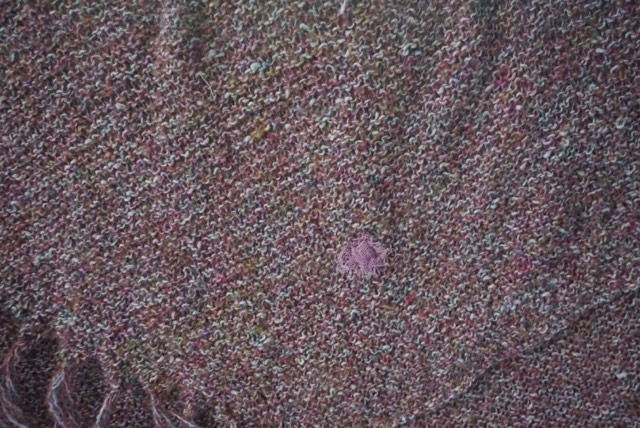
For this body of work I have taken my inspiration from photographs and archives of weaving mills in the north of England. I decided to knit a series of shawls to illustrate the enormous differences in the social structure of society and wealth in the C19.

A mill worker’s shawl, knit in an oiled course wool, quite simply stitched, and later darned and patched.

The mill manager’s wife’s shawl, a fine wool shawl with hand stitched embroidery in fine wool.

A pedlar’s shawl, advertising the ribbons and threads sold to the millworkers. A simple knit, colourful shawl knit with torn and twisted strips of coloured silks to make a vibrant and unique knitted shawl.

I have used daisies, leaves, and sprays of wheat for the surface embroidery designs and used vintage silk threads and the fines wool.

For this body of work I have taken my inspiration from photographs and archives of weaving mills in the north of England. I decided to knit a series of shawls to illustrate the enormous differences in the social structure of society and wealth I the C19.

A mill worker’s shawl, knit in an oiled course wool, quite simply stitched, and later darned and patched.

The mill manager’s wife’s shawl, a fine wool shawl with hand stitched embroidery in fine wool.

A pedlar’s shawl, advertising the ribbons and threads sold to the millworkers. A simple knit, colourful shawl knit with torn and twisted strips of coloured silks to make a vibrant and unique knitted shawl.

I have used daisies, leaves, and sprays of wheat for the surface embroidery designs and used vintage silk threads and the fines wool.

Catherine Wilson

Catherine Wilson

Catherine Wilson

Catherine Wilson

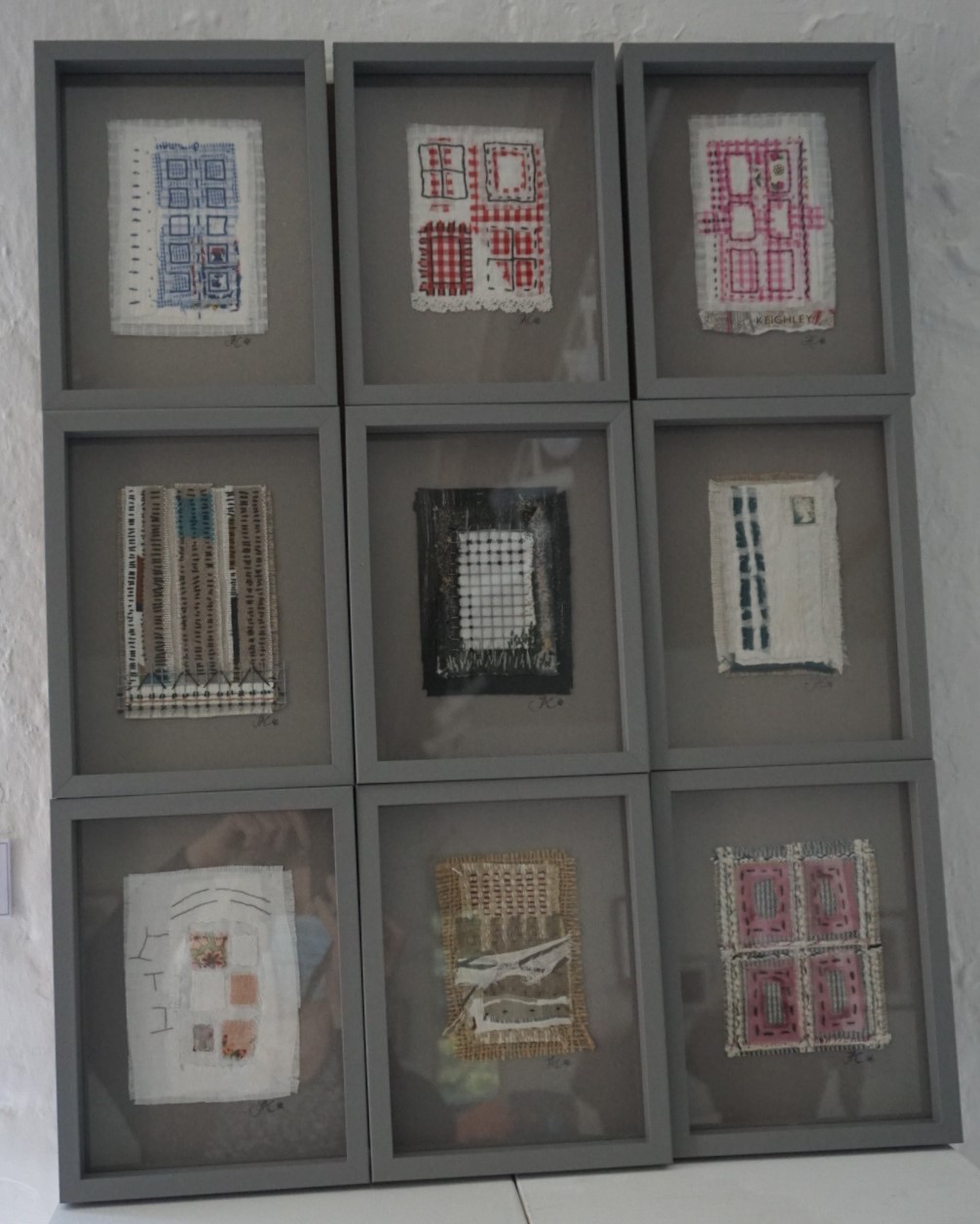
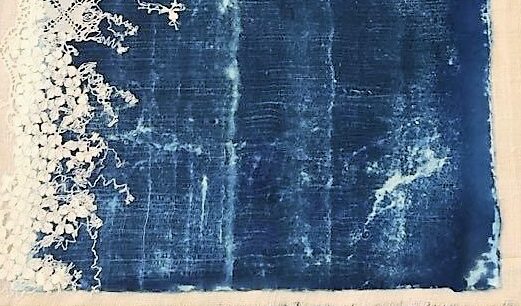
My work for this show ‘Thread Running Through’ references a beautiful collection of Victorian fabrics, once owned by a wealthy West Yorkshire textile manufacturer. This fascinating archive includes: – intricately embroidered cotton pillowcases, exquisitely hand painted Chinese wall panels, fine linen table clothes and delicate, lace trimmed, silk handkerchiefs. Each of these precious textiles would have been extremely expensive in their day, clearly demonstrating the wealth and status of the family. My work does not aim to replicate these items; however, the collection is a starting point, and my response is both abstract and emotive. Using my own equally treasures horde of well worn, household textiles to create each piece I have combined threadbare, patched and distresses scraps of cotton, linen and silk with handmade papers and cyanotype printing techniques. Captures behind glass, these treasured pieces are preserved and presented as in a museum archive.