Mill Workers
The photograph above shows most of Farfield Mills’ workers possibly around 1894 when there was significant development of the Mill complex.
The photograph above shows most of Farfield Mills’ workers possibly around 1894 when there was significant development of the Mill complex.
As more and more parts of the process of making woollen cloth were done by the new machines, less and less work went out into people’s homes. The people who came to work for the Dovers at Farfield Mill would have found it very different to what they were used to.
Machines run at a regular pace, which must be kept up with. Mill owners made money by pushing both the machines and the people who ran them hard. The rules and regulations were strict, and punishments could be severe. People no longer sang and told each other stories as they worked.
Standing about doing nothing was strictly forbidden. The steel columns in this mill were painted a silvery-white colour, which showed marks if any workers leant against them with the greasy work clothes!
The regular money helped however, and many mills ran clubs and brass bands to keep their workers happy. The Dovers seem to have been firm but fair. We know that on special occasions they held parties for their workers.
Their workers also lived long lives and families such as the Leightons and Masons worked for them from the day Farfield Mill opened, to the day the Dovers sold up in 1937.

Life in the mill was hardest for the children. In the early 19th century, children as young as 3 years old could be found working in textiles mills. The long hours, and the dangerous conditions mean that children were particularly likely to be severely injured or killed.
We are aware of one accident from a report in the local paper ‘The Westmorland Gazette’ 25 July 1846
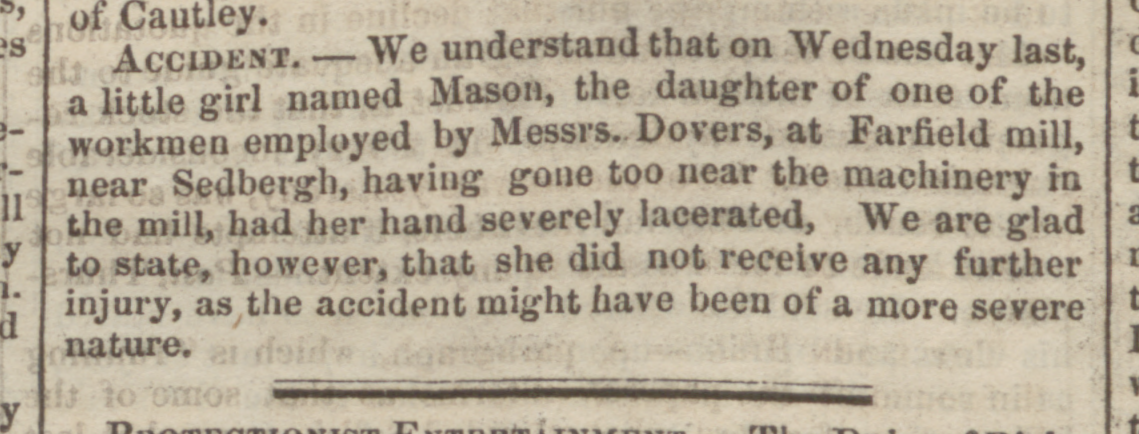
©British Newspaper Archive
We know that children certainly worked at both Dover managed Mills Hebblethwaite and Farfield, but it seems that the Dovers would not allow them to be mistreated as this letter about the sacking of one of their Hebblethwaite Mill employees shows:
“.. he not only absented himself from his work without leave but also when he was at work he created nothing but disturbance amongst the other work people by his abusive language and likewise he had without any cause whatever knocked down and abused some of the children in the Mill.”
Joseph Dover 1831

Children on their way to work in a mill, From Walker’s The Costume of Yorkshire 1814 ©YDNP
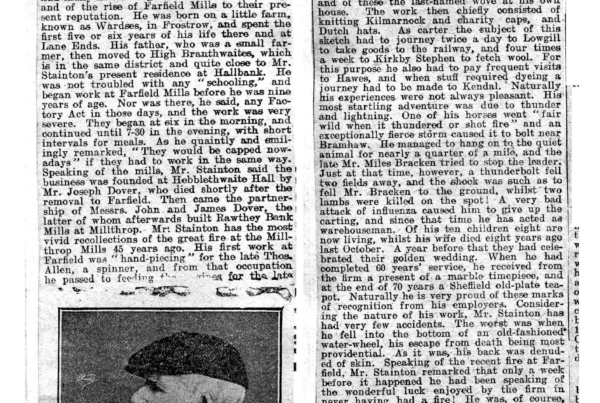
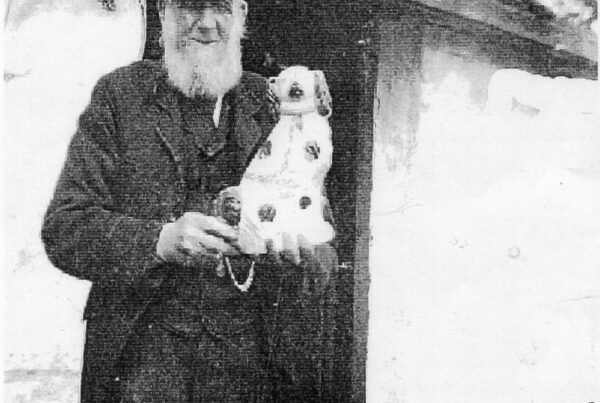
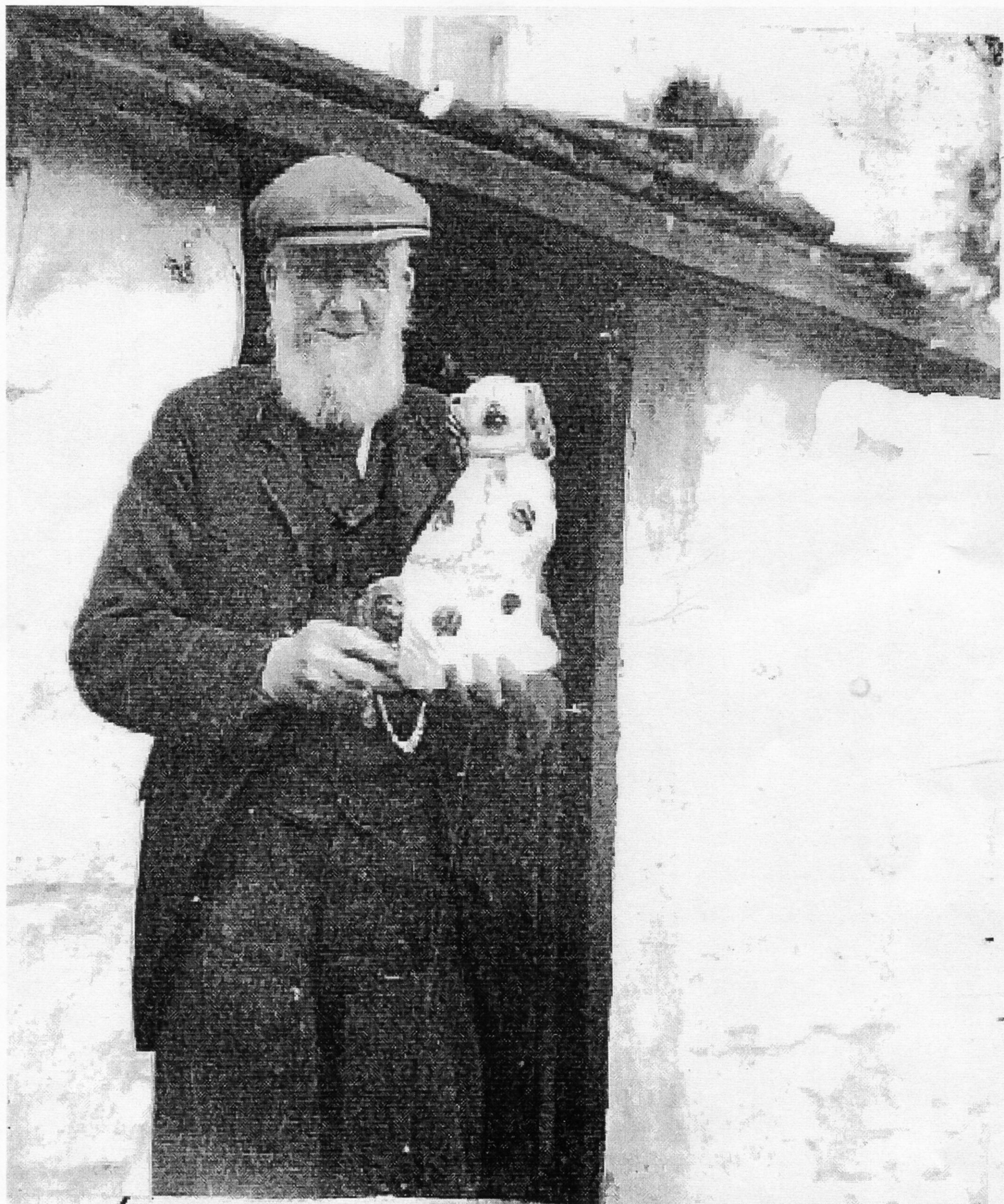
William Stainton was described as a boy ‘not troubled with any schooling’, he started aged 8 at Farfield Mill, on the day Farfield Mill opened in 1837. He began work each day at 6.00am and finished at 7.30pm. Like many small children, his first job in the mill was a piecer, for a spinner names Thomas Allen. Later he went on to ‘feeding the engine’ with Thomas Leighton.
He clearly didn’t like work and often played truant. Once they had to send out a sniffer dog to find him hiding in the woods. The job was also dangerous. One day her was sent to clean out the waterwheel pit and was nearly killed when the wheel caught him and took most of the skin off his back.
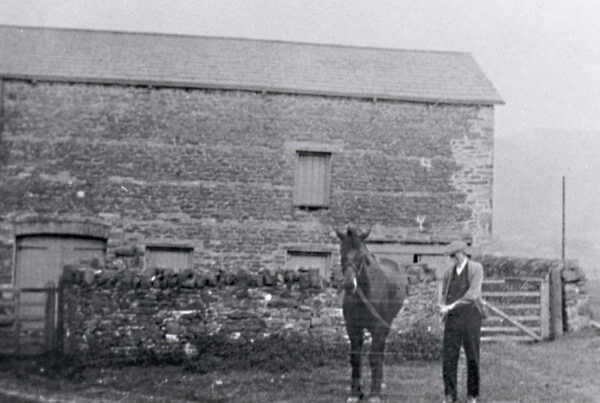
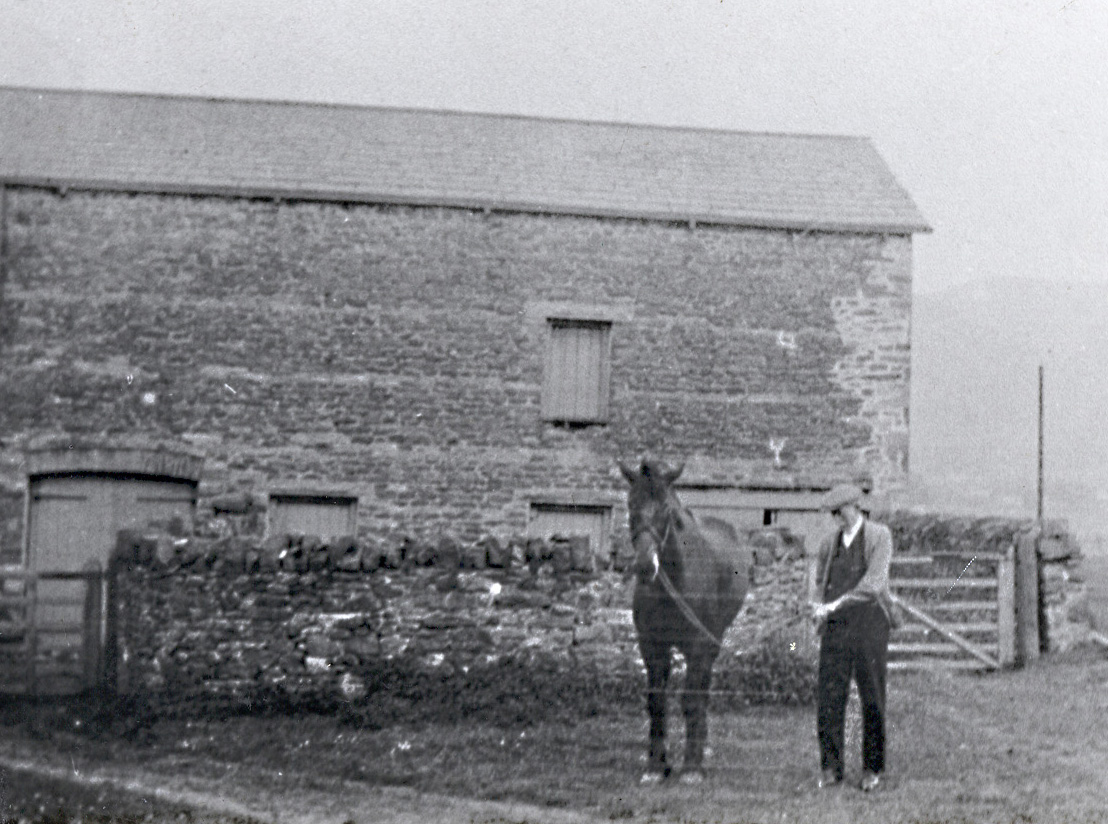
He survived however, and after catching the flu and nearly dying aged 17, he was set to work outside the dusty atmosphere of the mill, and spent the rest of his days as a carter and coachman. He carried raw wool to the mill, and finished goods away. In a day he was expected to travel to and from places as far away as Hawes, Kendal or Kirkby Stephen.
He finally retired after 86 years of service at Farfield Mill and received a special medal. When he died soon after, all the mills were closed and the workers along with the Dover family went to his family.
This lovely photograph is of the Wallace family standing out side The Row mill cottages built by the Dover family in around 1850.
We know using the Census Data of 1901that the Wallace family consisted of …James Wallace born about 1841 in Aberdeenshire who was a woollen textile dyer,
His Wife Janet Wallace born about 1841,
His son William Wallace born about 1879 in Yorkshire who was a woollen weaver,
His son in law John L Hall born about 1977in Sedbergh who was also a woollen weaver.
Jane Hall (nee Wallace) born about1878 in Sedbergh married to John L Hall.

©Sedbergh History Society