Out of Synch - Theo Wright

synchronisation and sequencing

Out of Synch – Theo Wright Handweaver

14 April – 22 May 2021

Out of Synch is a project that explores the synchronisation and sequencing of design elements in a series of woven textiles: single cloth woven in linen and double cloths woven in silk.
By disrupting simple colour and pattern sequences, they become more complex and move in and out of alignment.
The same approach has been applied to a range of weaving styles. All the textiles were handwoven on a 16-shaft dobby loom.

Detail of Lozenge – Theo Wright

lozenges – Theo Wright

Detail of Lozenges – Theo Wright

Repeats

The main approach I have used takes two independent repeating sequences and ensures that the length of the repeat of one is longer than the repeat of the other. The effect of this is that the two sequences go in and out of alignment. This approach can be applied in a number of ways.

Stripes

The simplest example is this piece.
Here, each stripe has three independent components: the width of the stripe, the weave structure of the stripe and the colour of the stripe.
If the repeat for each component were the same, say five, then a simple sequence of five stripe widths, five structures and five colours would give an overall repeat of just five stripes.
In my version, the repeats are different: there are three stripe widths, four structures and five colours with an overall repeat of 3 x 4 x 5 = 60 stripes.
In practice, the textile is less than 60 stripes high so, the pattern actually never repeats.

Detail of Stripes – Theo Wright

Detail of Stripes – Theo Wright

Stripes – Theo Wright

Stripes – Theo Wright

Detail stripes – Theo Wright

Detail stripes – Theo Wright

Checks

This check design uses bold contrasting stripes in warp and weft.
Conventionally, the colour stripes would synchronise with the block structure of the weave so that, for example, the dark areas can be woven with one weave structure and the light areas with a different one. ​
In my version the colour stripes are wider than the block structure, so the weave structures are not in synch. with the colours, giving a more complex pattern.

Detail of Checks – Theo Wright

Checks – Theo Wright

Detail of Checks – Theo Wright

Double Cloth Colours

I’ve applied the same idea to a double cloth structure here.
One layer of cloth uses four dark colours and the other uses three light colours. ​
The stripes in each layer are wider than the block structure of the double cloth so the colour changes do not always occur at a block boundary (both horizontally and vertically) adding subtle complexity to the design.

Detail from Colours II – Theo Wright

Detail from Colours II – Theo Wright

Colours II – Theo Wright

Colours II – Theo Wright

Detail Colours II – Theo Wright

Detail Colours II – Theo Wright

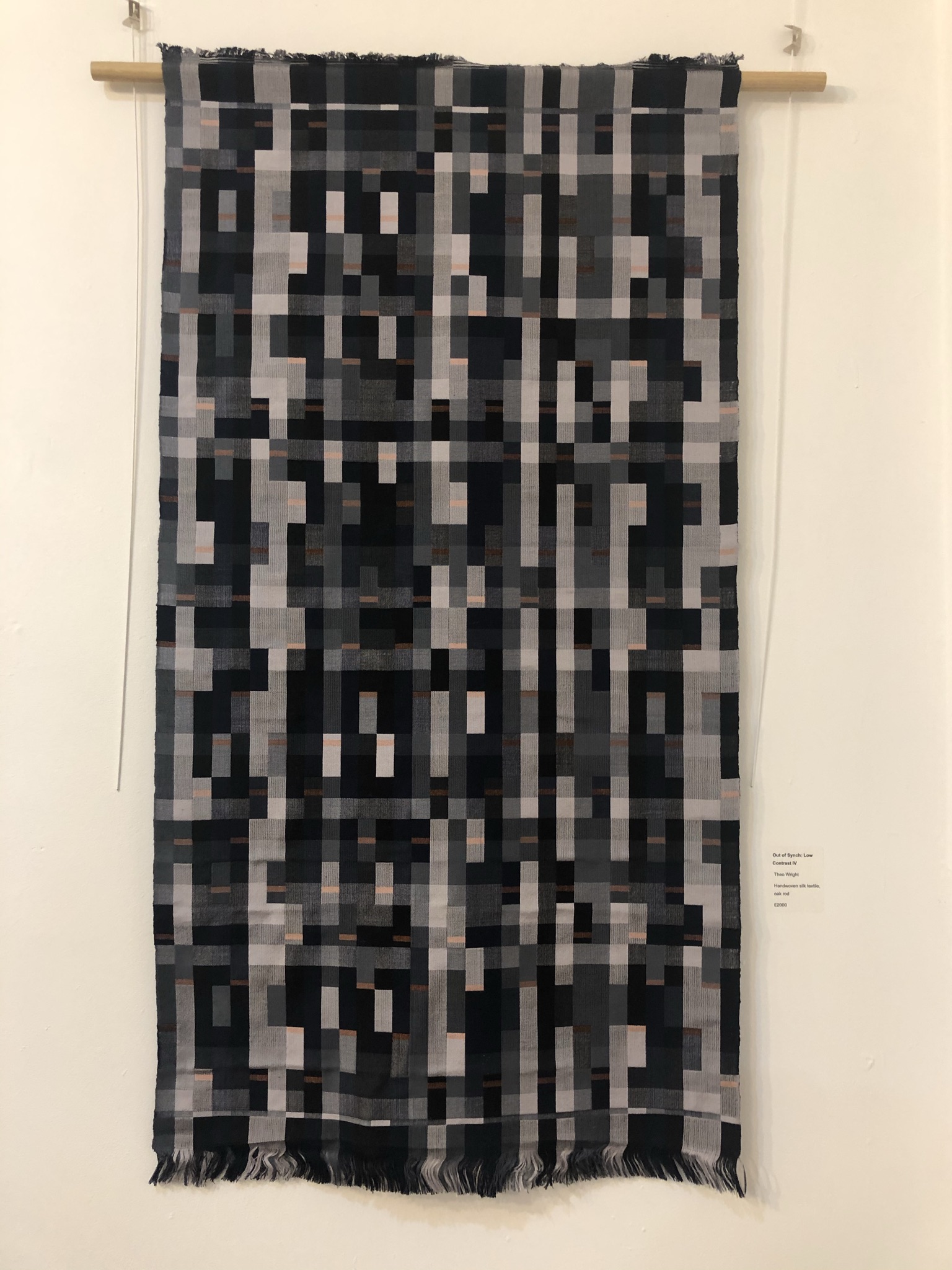
Contrasting Colour Bars

Here the lack of synchronisation is much more obvious.
​The main block structure of the double cloth, woven in shades of blue and grey, is out of synch. with the horizontal orange bars.
This design element appears to travel up the cloth independently of the main block structure.

Low Contrast – Theo Wright

Low Contrast – Theo Wright

Low Contrast 4 – Theo Wright

Low Contrast 4 – Theo Wright

Detail of Low Contrast 4 – Theo Wright

Detail of Low Contrast 4 – Theo Wright

Waves

This design harks back to my previous project When Waves Collide.
Here there are two interleaved waveforms woven into the fabric.
​The two waves have different wavelengths so, once again, they are not synchronised, but move in and out of alignment vertically through the textile.

Detail of Waves 1 – Theo Wright

Waves 1 – Theo Wright

Detail of Waves 1 – Theo Wright

A sequence that slips

The second approach I have taken is one that can be applied to a single sequence. I think of it as “skipping a beat”, similar to a cog with a broken tooth that slips on each turn.
Here a simple repeating sequence such as ABCD, ABCD … is replaced with one that slips regularly ABCD -BCD A-CD AB-D ABC- … (in this case, missing every fifth element) giving a new longer sequence: ABCD BCDA CDAB DABC.

Twills

In this piece I have used this approach to disrupt the block threading.
This design is based on a block threading with two contrasting blocks, one woven in 1/3 twill, the other in 3/1 twill. For a simple chequerboard pattern, one block might use straight threading on shafts 1-8 and the other on shafts 9-16 giving a sequence of 1-8, 9-16, 1-8, 9-16…
In my version the sequence misses every 9th beat, so that it becomes 1-8, 10-1, 3-10, 12-3… resulting in a much longer repeat. Using the same principle for the lifting sequences this produces a much more complex pattern.

Detail of Twills – Theo Wright

Detail of Twills – Theo Wright

Twills – Theo Wright

Twills – Theo Wright

Details of Twills – Theo Wright

Details of Twills – Theo Wright

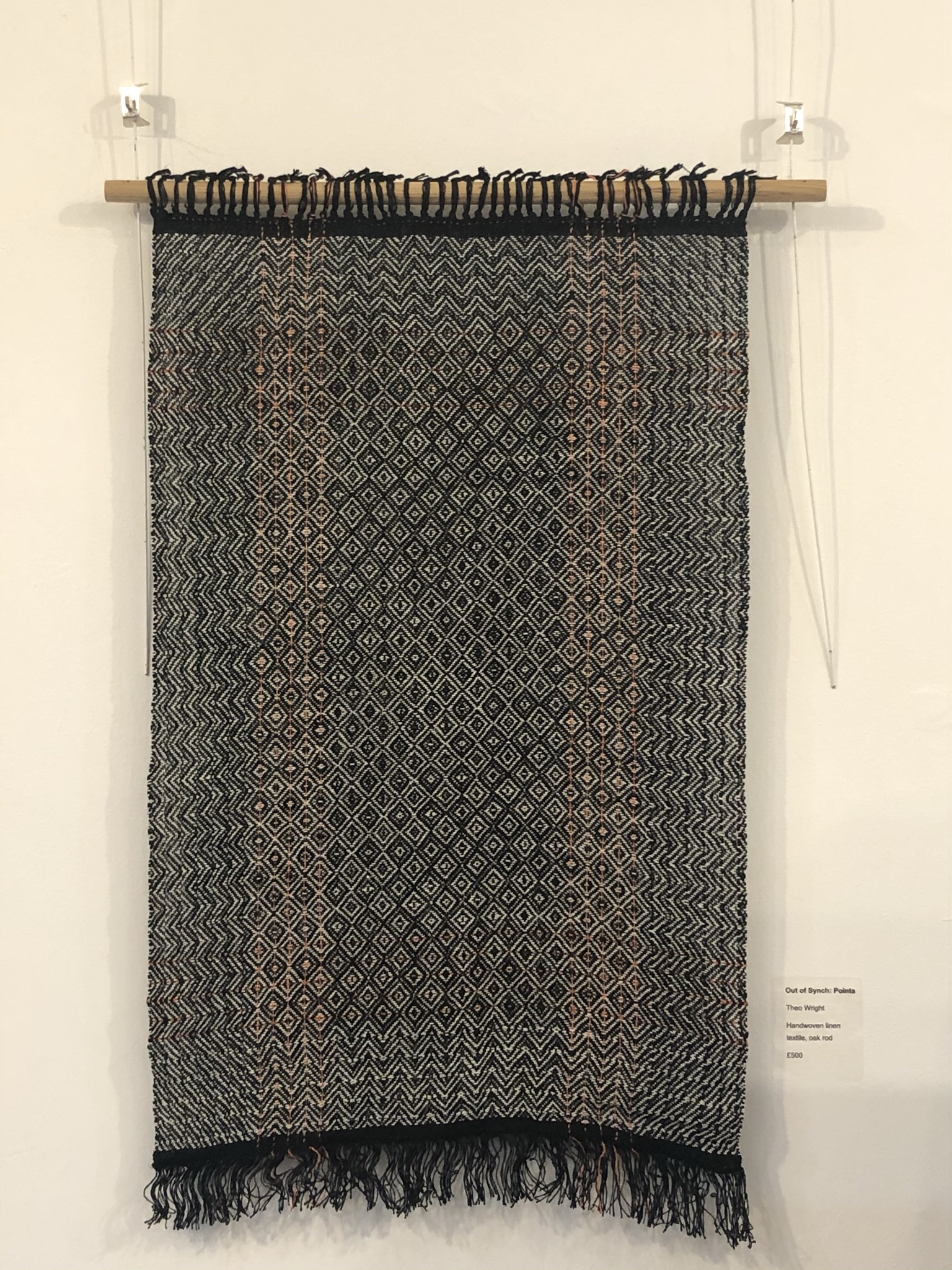
Points

In this piece, a similar approach produces a version of a progressive point twill woven on 12 shafts. It is based on a simple point threading sequence:
1 up-to 12 down-to 1 up-to 12 down-to 1…
By changing direction one shaft early on every rising and falling line, I have changed it to: 1 up-to 11 down-to 2 up-to 12 down-to 3 up-to 1 down-to 4…

Detail of Points – Theo Wright

Points – Theo Wright

Detail of Points – Theo Wright

About Theo Wright.

My design process is both structured and exploratory. I start at the computer using a spreadsheet like electronic graph paper, to investigate an idea and develop woven textile designs. I then move to the loom and weave samples of these designs, combining patterns and experimenting with yarn colours.

I enjoy the rhythm of handweaving and the attention to detail that this process affords. Designing and developing a woven textile from start to finish, from concept to cloth, by hand is a very satisfying, but slow, process.

I love to explore the interaction of colour between warp and weft, and the contrast between dark and light colour values; developing surprising combinations within a rich autumnal palette. As a man in the predominantly female world of textile design, I am particularly keen to ensure that my work includes designs and colours that will appeal to men.

Since 2011 I have made scarves for sale, weaving them on a small Ashford eight-shaft table loom and selling online and at major craft fairs. With the recent acquisition of a Louët 16-shaft floor loom, I am now able to make larger work.

In 2014, I was a participant in the Crafts Council’s Hothouse maker development programme. My experience on this scheme led to a new direction, and I was fortunate to be awarded  a grant by Arts Council England to create a series of non-functional woven textiles based on the mathematical idea of Permutations. This work was first shown in an exhibition at New Brewery Arts, Cirencester in June 2015.

In 2016 I developed a project When Waves Collide with funding from Arts Council England and Coventry City Council. A selection of the resulting textiles were shown in the Craftspace touring exhibition Made in the Middle 2016 – 2018. A solo show at the National Centre for Craft and Design followed.

Another project, Out of Synch, was exhibited at various venues from 2019, most recently at Farfield Mill. My latest project No Colour No Contrast is currently in development and will be on show in Coventry and London from Summer 2021.

http://www.theowright.co.uk/

https://www.facebook.com/TheoWrightHandweaver