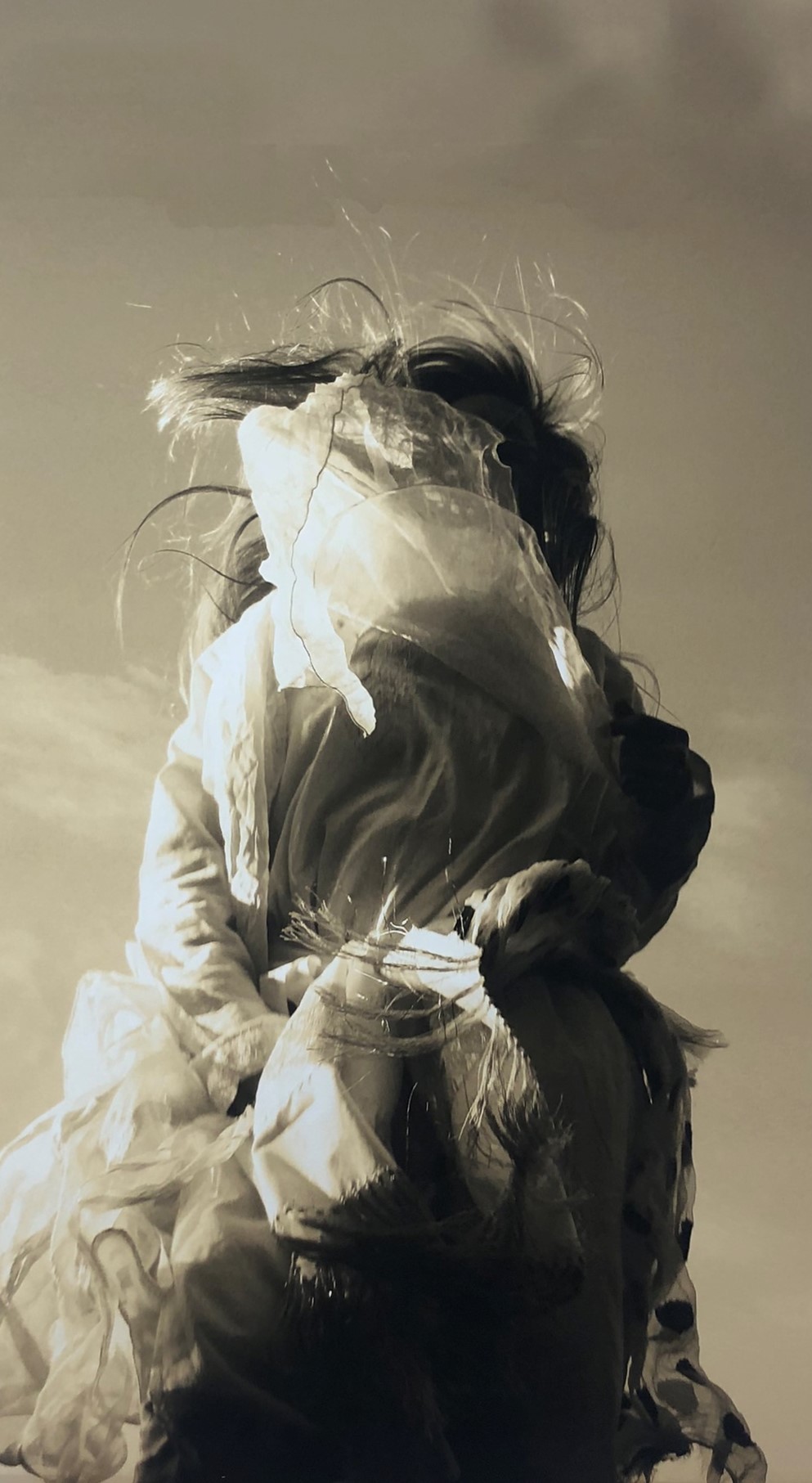
Exspiravit - Decorum

11 January - 2 April 2023

Exspiravit – Decorum

11 January 2 April 2023

Decorum is a group six women artists who work in close collaboration – they formed the group in 2017 and continue to work in relation to textile ephemera. Their practice takes on many forms as they aim to convey traces of past lives through the observation of the present.

Each artist studied at Manchester School of Art in the Textile Department and since graduating they have all continued to make work relating to stitch, print and mixed media painting. Although as individuals their textile practice has taken them in different directions, their passion for historical textiles has remained a constant facet of their work; using techniques that are rooted in textile history has been a common thread that binds them together in their making processes.

Their exhibition ‘Exspiravit’ sees them execute new works inspired by the wonderful Rachel Kay Shuttleworth Archive housed within Gawthorpe Hall. This incredible collection gathered over decades is an enduring resource for artists and designers alike. Inspirational and informative, their access to the archive allowed them to unravel textile narratives that lay hidden in the hundreds of boxes stored here at the hall.

Working directly from the collection enabled them to make detailed drawings from the embroidered, woven, printed fabrics and garments in the collection, challenging them to look closely and to tease out their individual narratives. Many of the examples are faded, frayed and fragile pieces of cloth and clothing all of which must have been treasured and used in the daily lives of people from another time and space. Other times they would open a box and be surprised to find the fabulous condition of an item that had never lost its colours and had been meticulously cared for.

The beauty of the collection is that each piece has its own story to share bringing them closer to the intimate traces of a worn garment or a fabric loved. The owner of that piece maybe gone but not without trace, a small piece of them is here preserved in Rachel’s archive forever.

Christine Stanford

Christine Stanford

Christine Stanford

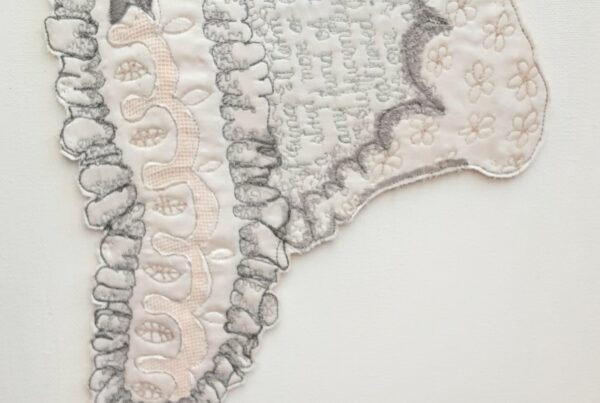
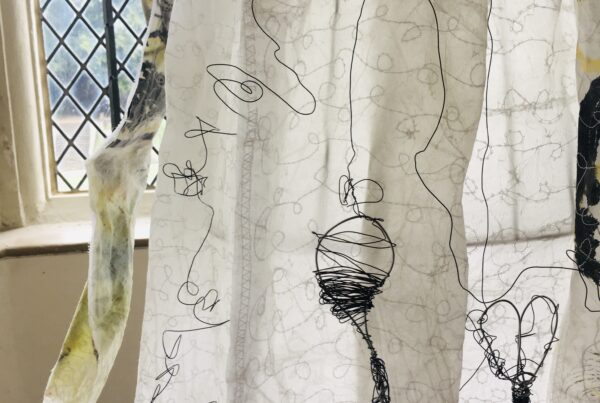
My love of costume and researching social history and people’s lives has inspired me to spend time researching costume archives and looking at the detail and skills that went into the construction of the costumes. It is such a privilege to look at all the exquisite pieces and to reinforce how important it is that they are preserved and not lost in history.

The pieces that I have created for this exhibition allowed me to indulge my interests and explore the idea of fragility which can mean different things on different levels, in this instance the costumes present a delicate frail quality but also represent the fragility of life and how it’s important to appreciate every moment. I love the opulence and richness of historical costumes and the exquisite detail that is evident in every part of the costume.

The delicacy in my work is created by using hot wax, trapping fabrics and hand painted papers and images with stitch then manipulating the waxed papers to create structures. I embellish the structures using machine and hand embroidery then add handmade resin buttons with images trapped within them creating a time capsule.

Diana Morrison

Phantom Garden – Diana Morrison

Phantom Garden – Diana Morrison

Ghosts – Diana Morrison

Ghosts – Diana Morrison

For my work in Expiravit, I have explored 2 strands of perception, being the dichotomy between the formal elements of interaction with the collection at Gawthorpe Hall against the theoretical premises of philosophical exploration on developing more abstract ideas generated by my research.

I was initially drawn to the complexity of the structure of the exquisite samples of lace in the wonderful Rachel Kay-Shuttleworth collection, some created from a network of strands of fine wire. Then I discovered a portrait of one of the ancestors of the collector, Fleetwood Shuttleworth, pictured with her mother Mary Barton, both wearing lace Rebato collars in the fashion of the time.

At the same time, I had been reading the Four Quartets by T S Eliot, exploring the concept of time and querying our perception that this is a purely linear process and wanted to see how this idea would fit with my work.

In the Elizabethan period, lace was so expensive to produce that it was usually re-imagined and recycled as fashions changed. Lace was used again and again and lace collars such as those worn by Fleetwood and her mother are very rare to find in their original form. I wondered if there was a possibility that a fragment of Fleetwood Shuttleworth’s collar could have resurfaced as a different artefact in her descendant’s collection.

Imagining a place outside of time, perhaps Fleetwood and her mother were able to see me as an intruder in their house as.

‘Time present and time past
Are both perhaps present in time future,
And time future contained in time past.’

My collar is a re-imagination of those worn by Fleetwood Shuttleworth and Mary Barton, transposing time past into time present as Fleetwood and her mother re-emerge into the 21st century. Lace is also present as a trace element in a ghostly memory of its previous incarnation.

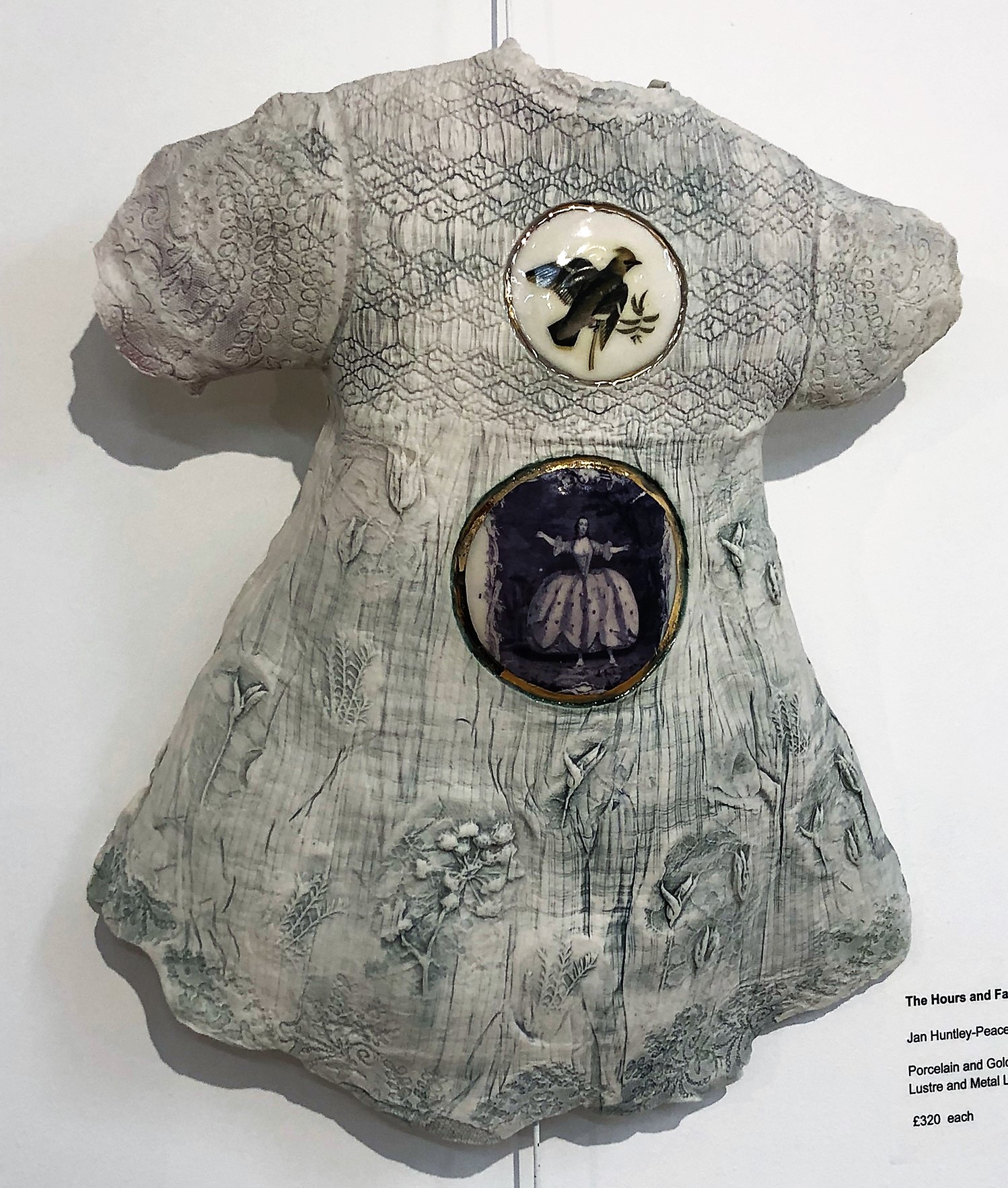
Jan Huntley-Peace

The Hours and Fates – Jan Huntly Peace

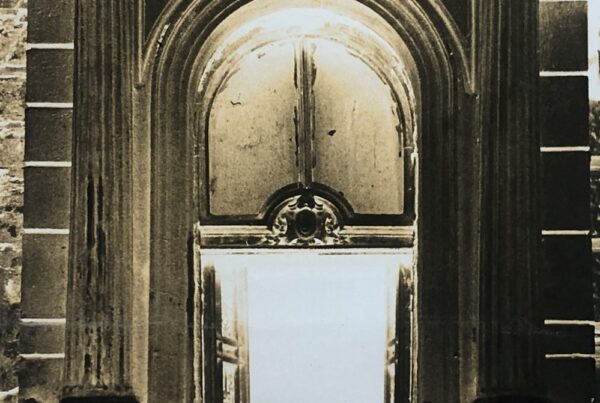
Facade – Jan Huntly Peace

Gift – Jan Huntly Peace

Porcelain and Print
Jan is an award-winning artist who uses print and frottage to reveal and reflect on a moment in time, capturing the memory of an object using direct print from antique clothing, textiles, and using bird/butterfly and botanical imagery to express ideas of transition and transformation. Her work occupies an ambiguous space between the real and the symbolic, reality and myth.

She started her career in couture dressmaking with Zandra Rhodes and went on to work with Jean Muir, David, and Elizabeth Emmanuel and in an international capacity for the Queens dressmaker, Norman Hartnell.
Now as a professional artist for over twenty-five years using a variety of materials, found objects and techniques. Jan is now working with mainly porcelain and produces figurative sculpture, portraits, and small vessels. They are delicate and textured, her ceramic technique is self-taught, using her couture dressmaking skills working with fine chiffon and lace to drape fabrics directly onto a figure.

Jan exhibits widely and her work is in collections across the country. She works and teaches from her studio and home at Crofts Farmhouse, Leasgill, Milnthorpe, Cumbria.

www.janhuntleypeace.co.uk
www.instagram.com/janhuntleypeace

Rosie Wates

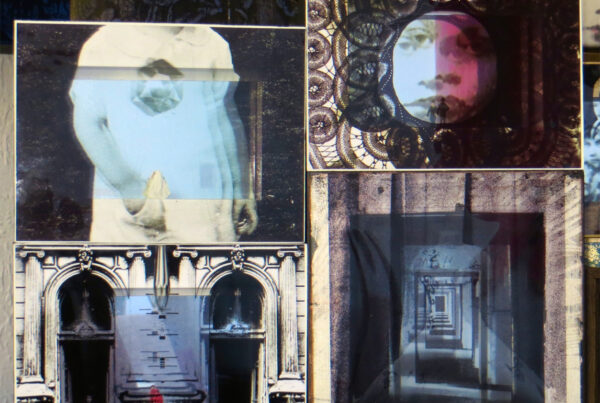
Theatre Boxes – Rosie Wates

Theatre Boxes – Rosie Wates

Theatre Boxes – Rosie Wates

Portal – Rosie Wates

Angel – Rosie Wates

Rosie

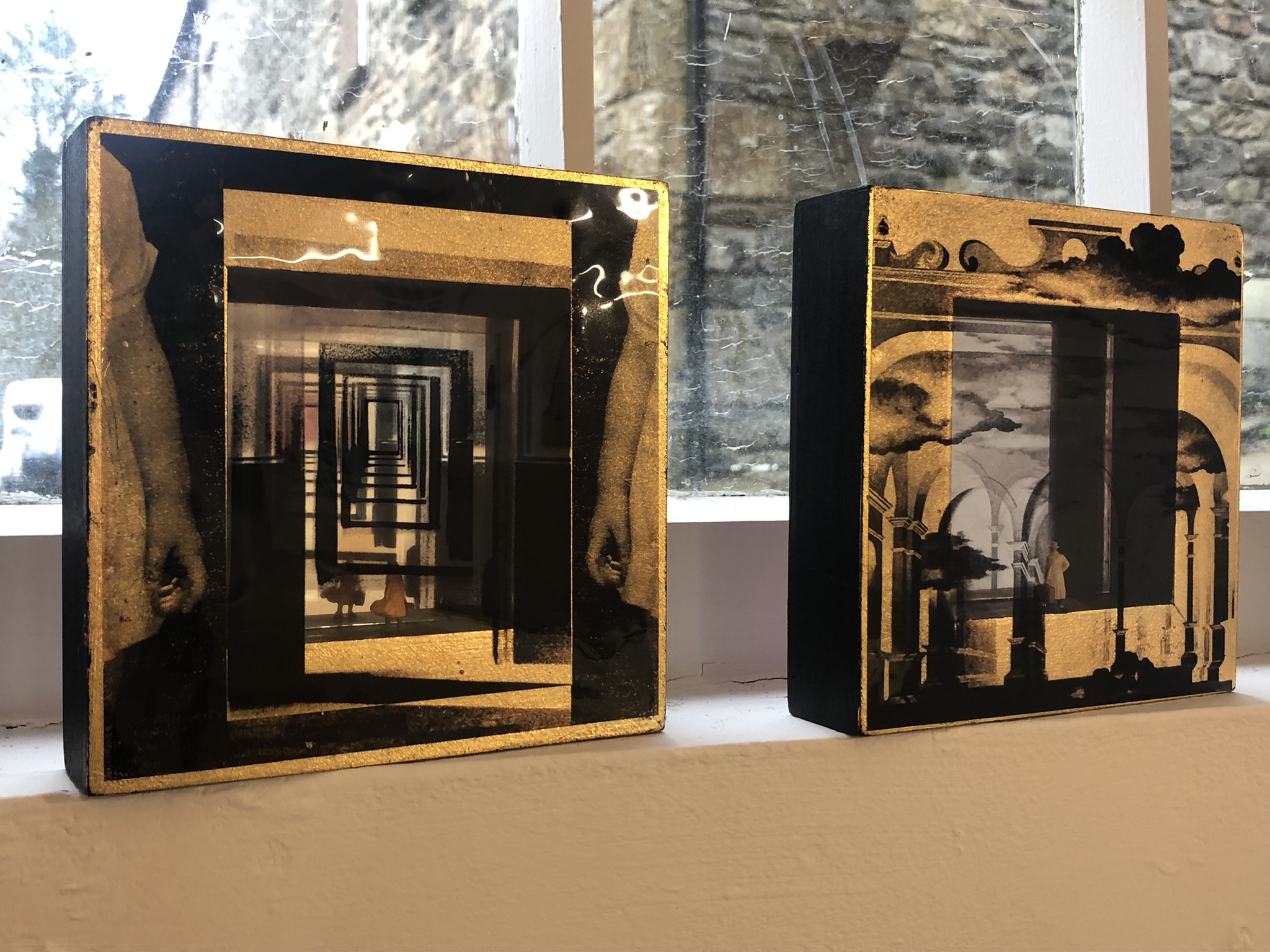
Rosie Wates reaches for the shadows of time past, embedding haunting photographic images using photogram, gold leaf, collage, mirror, paint. The artist’s personal and family histories (living in/coming from Russia) become emblems of the fleeting stories of the many lives that might pass and leave nothing behind.  She then constructs in time present objects that stubbornly strive to carry their whispers into time future, speaking of belonging/stranger, outside/inside, making a mark/leaving no trace, memento and memoir.

Val Jackson

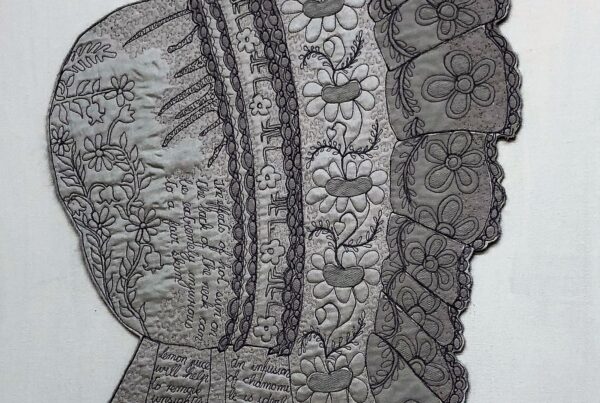
The Maiden Aunt – Val Jackson

The Dowager – Val Jackson

Val

My work for this exhibition represents the study of the function of clothes & accessories in telling the stories of the past & helping define the identities of the people who played a part in them. These items are visual evidence of where & what they were at any given time. Rescued garments & accessories such as bags, caps, shoes, & other small clothing items serve as markers of the place in life of the person who wore them & of the times themselves from which they devolve. They encapsulate the times when they were worn and provide the background of the age, status, social position & likely occupations of the women who wore them.
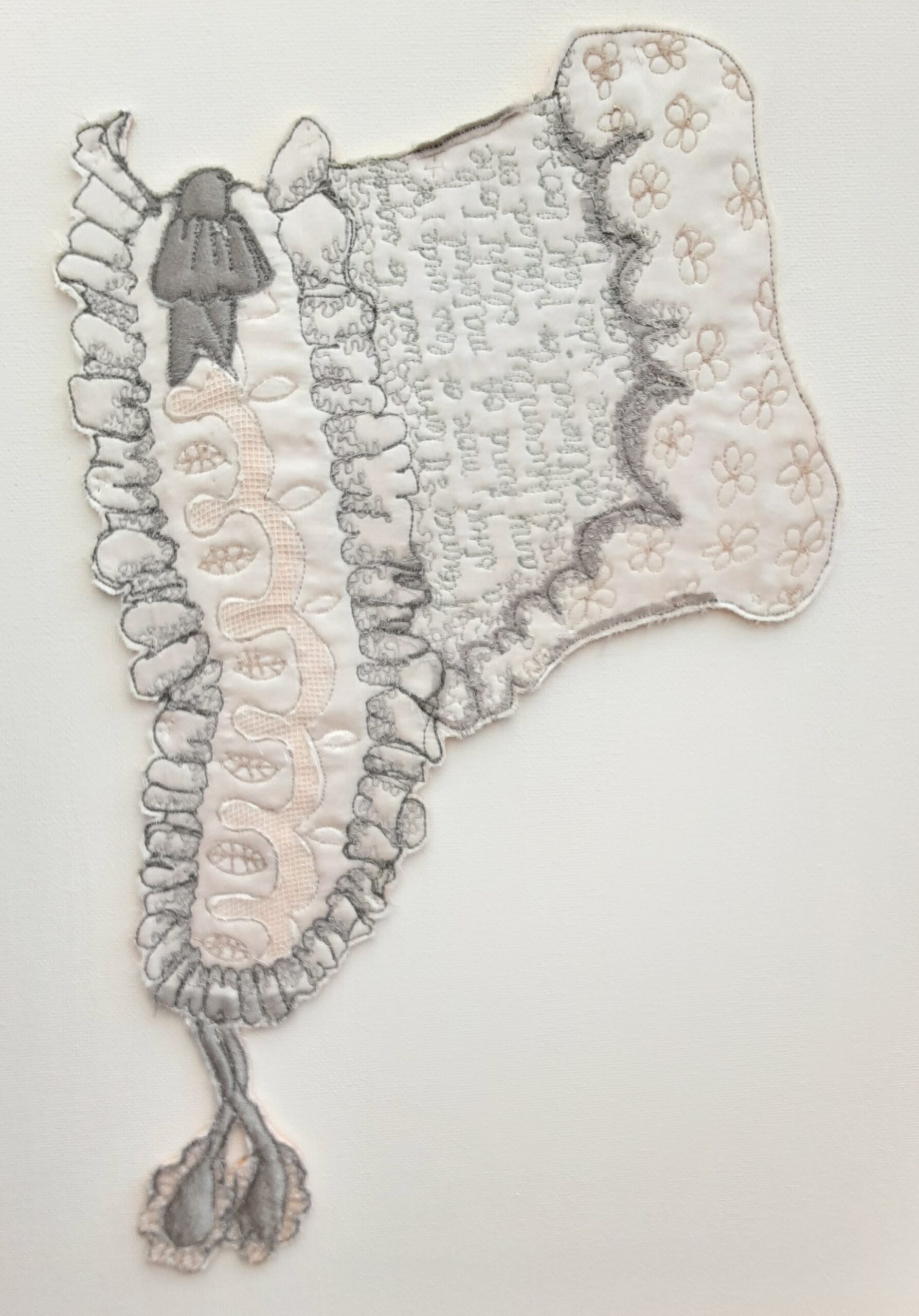
The white cotton, silk & lawn caps of the mid-19th Century accomplish these aims more simply & sharply than almost any other garment. Women of the industrial 19th century were very much confined to the house, especially in urban areas. Towns & cities were seen as filthy & dangerous during this period & women’s jobs were seen as either creating or adorning clear, safe, sweet-smelling spaces away from the smells, dirt, noise of the streets. These clean white caps were the emblems of their positions in these havens. This, of course involved an immense amount of hard work for those domestically involved.
For those who were doing the domestic work the cap often defined their position in the house and kept the dust out of their hair. The ladies who employed them were also defined by their caps. Their age, their marital status, their prosperity, even the degree of their needle work skills were on display.

This time was also notable for the increase in mass publication whish strongly influenced the lives of the women of the period. The words quoted in these works are taken from these including Mrs Beeton’s book of Household Management, The Ladies’ Treasury, The Dictionary of Needlework (Caulfield & Saward), some contributions from The Subversive Stitch, & some words from my Great Grandmother’s Household book dated 1858.

All these pieces are made from layered cotton, silk & satin fabrics, utilizing reverse applique. The drawing & embellishment are all free machine embroidery.

Priscilla Edwards

Ghost Garden – Priscilla Edwards

Priscilla

I have been producing contemporary mixed media pieces since completing my degree in Embroidery at Manchester Metropolitan University in 1997.
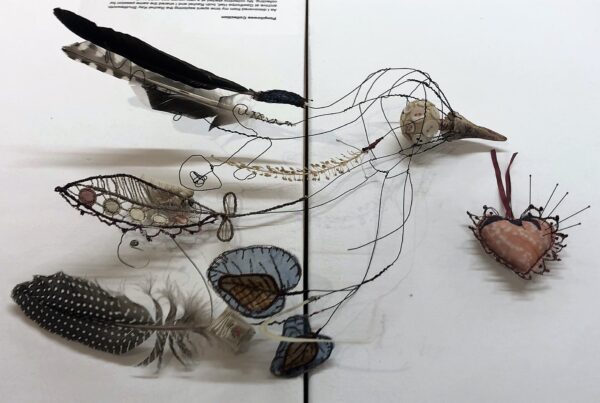
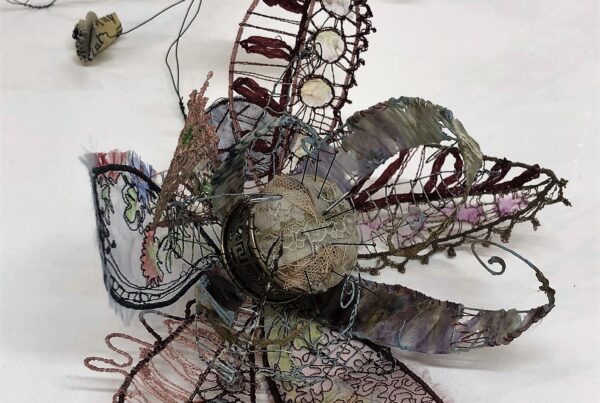
My current practice explores the concept of identity, memory and the translucency of time. Each piece is an example that has been manipulated and reworked through processes of embellishment that includes fabric, wire, porcelain, print and stitch. Assembled together, often-familiar materials and objects produce the field on which I develop a visual narrative that provokes the viewer to their own semantic exploration. The work resonates with us as emotionally; we recognize and react to the familiar, remembered, and implied links to things past. The associations prompted by nostalgia can be both comforting and provocative; we cannot fail to consider our relationship to the pieces through their powerful impact – these are evocative pieces that are haunting and atmospheric.
My work is exhibited across the UK, Europe and USA, with many pieces held in public and private collections – including the Embroiders Guild Educational Archive. Awards includes ‘Award for Excellence’ British Craft Trade Fair 2002, ‘Best Product at Flair’, Belfast 2006, ‘Best Stand’ at The Art Market in Holmfirth 2009
Priscilla has taught in FE, HE and Adult education for 20 years and currently works on the ‘BA Textile’ Programme at the Open College of the Arts. She also runs independent workshops for schools, colleges, museums and galleries.

Pimpilowes

Pimpilowes – Priscilla Edwards

Pimpilowes – Priscilla Edwards

Pimpilowes – Priscilla Edwards

Pimpilowes – Priscilla Edwards

As I discovered from my time spent exploring the Rachel Kay Shuttleworth archive at Gawthorpe Hall, both Rachel and I shared the same passion for collecting. My collecting started at a very young age and I can’t event remember a time when I wasn’t collecting. My earliest memory of specifically collecting textiles was visiting jumble sales as a child with my mother and grandmother around the same time I first learned how to hand stitch at the age of 5. One of the first finished stitched pieces I ever made was a pincushion out of felt, it was a gift for my great aunt who loved sewing and encouraged my love of collecting found materials and repurposing them.

Pincushions have an interesting history and have been known in a variety of names. “The first recorded origins of pincushions date back to the Middle Ages of Europe. In the English language, they became known by many names: “pimpilowes, pimpilos, pimplos, pimploes, pin-pillows, pin-poppets”. Other references to pin cases during the medieval era exist and by the 16th century, these were supplanted by references to “pyn pillows”.”

It struck me when I saw the collection of pincushions in the archive just how important these small and insignificant items are. These exquisite intricate examples demonstrate the significance of such an overlooked textile object and as an embroiderer it made me consider them more deeply as someone who stitches everyday how could you manage without one?

I have tried to create a collection that draws upon many different aspects of the pincushion from its construction to its embellished. I used the archive as a point of reference to inspire decoration, shapes and textural qualities but also incorporated ideas from my own collection of pincushions.